
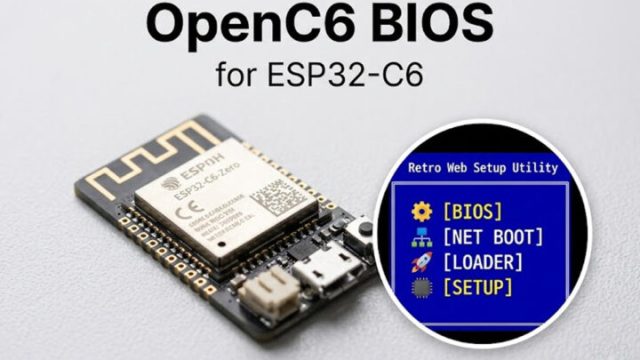
The recent advancements in microcontroller (MCU) technology are reshaping the landscape of software development and firmware management. The OpenC6 BIOS project by Rompass is at the forefront of this transformation, introducing a novel approach that enhances the flexibility and efficiency of the ESP32-C6 MCU. As devices become increasingly interconnected and complex, the demand for more modular and scalable firmware solutions is more pressing than ever.
Understanding OpenC6 BIOS
OpenC6 BIOS is an innovative, open-source project that redefines the way firmware operates within the ESP32-C6 microcontroller. Unlike traditional firmware systems where hardware configuration and application code are tightly bundled into a single image, the OpenC6 BIOS adopts a more segmented approach. This separation allows developers to run the system and application code independently, facilitating easier updates and modifications.
The Benefits of Modular Firmware
- Efficient Updates: With OpenC6 BIOS, developers can implement changes without flashing the entire firmware. This modularity enables quick updates to specific components, significantly reducing downtime.
- Improved Resource Management: The BIOS handles hardware initialization and system-level functions, freeing up valuable resources for application payloads that can run from RAM or flash memory.
- Enhanced Flexibility: Developers can load small, targeted payloads as needed, promoting a more dynamic programming environment that can adapt to various situations.
How OpenC6 BIOS Works
The core functionality of OpenC6 BIOS revolves around its ability to manage separate payloads through a simple Application Binary Interface (ABI). This system enables different software components to interact seamlessly without the need for an entire firmware cycle. The process involves:
1. Network Boot Capability
One of the standout features of OpenC6 BIOS is its support for network booting. This capability allows the ESP32-C6 to load software updates or payloads directly from the internet, streamlining application deployments and ensuring that devices remain up-to-date with the latest security features and functionalities.
2. Over-the-Air (OTA) Updates
With built-in OTA support, developers can push updates remotely, a critical feature for embedded systems that may be deployed in hard-to-reach locations. This function not only enhances user experience but also significantly improves device lifecycle management.
Why This Matters Now
As we move further into an era dominated by the Internet of Things (IoT) and smart devices, the significance of efficient, scalable firmware solutions cannot be overstated. The OpenC6 BIOS project is timely, addressing the needs of developers who are grappling with the complexities of modern MCU applications. Here’s why this innovation is crucial:
- Increased Connectivity: Devices are expected to communicate seamlessly. OpenC6 BIOS supports this by ensuring that updates can happen without significant disruptions, which is vital for maintaining connectivity in smart environments.
- Security Enhancements: With more frequent OTA updates, security patches can be deployed rapidly. This responsive approach can significantly mitigate risks associated with vulnerabilities.
- Market Demand: As competition intensifies in tech-driven markets, companies that adopt efficient firmware solutions will have a competitive edge, making OpenC6 BIOS a strategic advantage for developers.
Conclusion
The OpenC6 BIOS project represents a pivotal shift in how firmware can drive MCU development, particularly for the ESP32-C6. By promoting modularity and offering advanced features like network boot and OTA updates, it sets a new standard for efficiency and adaptability in the rapidly evolving field of embedded systems. Developers looking to enhance their projects, optimize performance, and embrace new technologies will find OpenC6 BIOS an indispensable tool in their arsenal. As the demand for smarter, more connected devices continues to grow, the implications of this project are profound and far-reaching.